


































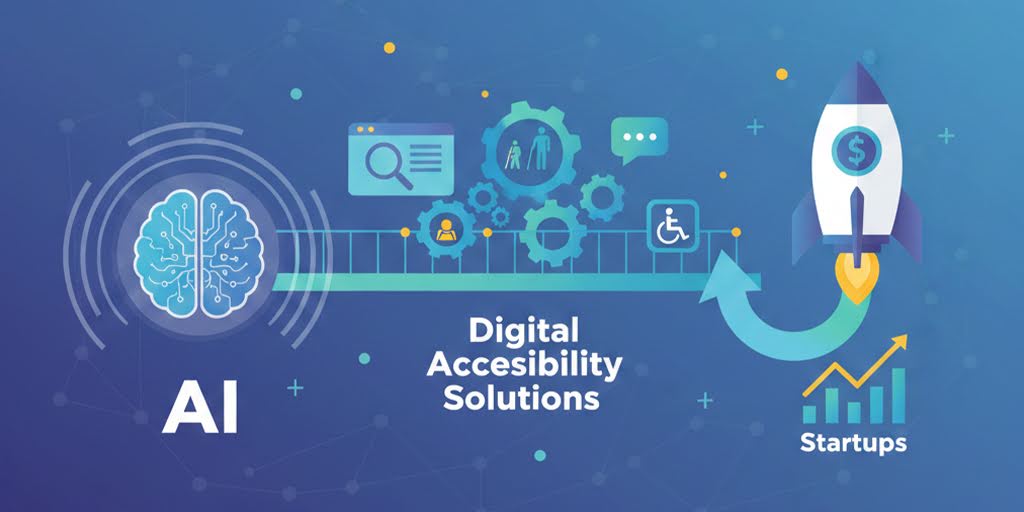
Introduction: AI’s Expanding Role in Startup Accessibility
Accessibility was once treated as a secondary concern in early-stage product development, often deferred until scale or regulatory pressure made it unavoidable. That approach is becoming increasingly risky. As digital experiences become the primary touchpoint between startups and their users, accessibility now influences credibility, adoption, and long-term sustainability – something every startup branding agency must now consider as part of building a future-ready brand.
Artificial intelligence is accelerating this change in practical ways. What previously demanded specialist teams and extended timelines can now be addressed earlier in the product lifecycle through intelligent automation. AI enables startups to detect accessibility issues faster, reduce manual remediation effort, and make steady progress toward compliance even with limited resources. This shift is central to how AI is changing digital accessibility for startups, allowing inclusive design to evolve from a post-launch fix into a foundational capability rather than a costly afterthought.
This blog explores how AI is helping startups make digital accessibility more practical, scalable, and achievable from the early stages of growth.
Table of Contents
Introduction: AI’s Expanding Role in Startup Accessibility
AI Innovations Powering Accessible Web and App Experiences
Advancing PDF and Document Accessibility Beyond Automation
Why Hybrid AI and Human Expertise Deliver Stronger Accessibility Outcomes
Top AI and Human-Led Accessibility Tools and Startups to Watch
Implementing AI-Driven Accessibility and Measuring Real ROI
2026 Trends Shaping the Future of Digital Accessibility
Conclusion: Building Accessibility as a Startup Advantage
AI Innovations Powering Accessible Web and App Experiences
Building accessible web and mobile experiences has traditionally required deep technical knowledge and ongoing manual checks. For startups moving fast, this often led to accessibility being addressed inconsistently or only after user complaints surfaced. AI is changing that dynamic by embedding accessibility support directly into development and content workflows.
Modern AI tools can automatically generate descriptive alt text for images, detect color contrast issues in real time, and support live captions for audio and video content. These capabilities reduce reliance on manual fixes while helping teams address common barriers as they design and deploy features. As a result, accessibility becomes a continuous process rather than a last-minute correction.
Beyond compliance, these innovations deliver measurable product benefits. Accessible interfaces are easier to navigate, faster to index, and more usable across devices. Startups that adopt AI-powered WCAG compliance tools for startup websites in 2026 often see improved engagement metrics and stronger SEO performance, reinforcing the idea that accessibility and growth are not competing priorities but complementary ones.
Advancing PDF and Document Accessibility Beyond Automation
While web and app accessibility has gained momentum, documents remain a major accessibility gap for many startups. Investor decks, onboarding guides, reports, and policy documents are often shared as PDFs that are visually polished but structurally inaccessible. Screen readers struggle with untagged content, incorrect reading order, and scanned files that lack usable text.
AI has introduced meaningful efficiencies in this area, particularly when paired with human expertise. Intelligent systems can detect document structure, apply semantic tags, and perform OCR on scanned files to make content machine-readable. However, true accessibility still depends on validation by specialists who understand context, hierarchy, and assistive technology behaviour. This hybrid approach ensures documents are not only compliant but usable.
Platforms such as documenta11y demonstrate how this hybrid model works in practice by remediating legacy and scanned documents to meet PDF/UA accessibility requirements. AI-driven tagging and OCR establish the structural foundation, while human review ensures reading order, semantics, and assistive technology compatibility are correctly applied. For startups managing growing document volumes, AI PDF accessibility remediation solutions for startups provide a scalable way to achieve consistent compliance without rebuilding documents from scratch.
Why Hybrid AI and Human Expertise Deliver Stronger Accessibility Outcomes
Relying on automation alone can help surface accessibility issues, but it rarely addresses the full spectrum of user needs. AI scanners are effective at identifying missing labels, contrast failures, or structural errors, yet they cannot fully interpret intent, content complexity, or how real users experience digital interfaces. This is where human expertise becomes essential.
A hybrid model combines continuous AI scans with targeted expert audits to resolve nuanced challenges such as cognitive accessibility, logical navigation flow, and meaningful content relationships. Accessibility specialists validate whether interactions make sense to screen reader users, assess clarity for users with learning disabilities, and confirm that automated fixes have not introduced new usability barriers. This layered approach improves both compliance and real-world usability.
From a startup perspective, hybrid models also make financial sense. Automated tools handle high-volume, repeatable checks, while human reviews focus on critical touchpoints and complex scenarios. This balance allows startups to control costs while maintaining quality, making hybrid AI human digital accessibility services startups a practical pathway to comprehensive compliance rather than a short-term patch.
Top AI and Human-Led Accessibility Tools and Startups to Watch
As accessibility expectations rise, startups are moving beyond one-off audits toward tools that fit naturally into fast product cycles. The most effective solutions today combine intelligent automation with expert validation, helping teams catch issues early while still addressing complex usability and compliance gaps. The platforms gaining traction this year are those that integrate easily with modern tech stacks and support both speed and accuracy.
Tools and platforms to watch
-
DocumentA11y
Particularly relevant when a startup’s product includes high-impact documents such as onboarding PDFs, policy documents, statements, and reports. The platform focuses on making documents and PDFs accessible, with services aligned to widely adopted standards including WCAG, PDF/UA, ADA, Section 508, and EAA requirements.
-
Deque axe DevTools
Widely adopted by development teams, this platform focuses on automated accessibility testing aligned with WCAG criteria. Its strength lies in early detection, allowing developers to identify and resolve issues directly within browsers, IDEs, and CI workflows before they reach production.
-
Google Lighthouse
Commonly used as a baseline accessibility check, Lighthouse helps startups monitor accessibility alongside performance and SEO. While not a replacement for deeper audits, it is effective for repeatable checks during development and release cycles.
-
Microsoft Accessibility Insights
Designed to guide teams through both automated checks and assisted manual testing, this tool supports WCAG-based evaluations and helps developers understand why issues matter, not just where they occur.
-
TPGi ARC Platform
Suitable for teams looking to combine automated scanning with structured evaluation workflows. The platform supports ongoing monitoring and complements manual testing, including assistive technology validation.
-
Siteimprove Accessibility Solutions
Often used by content-heavy platforms, Siteimprove focuses on continuous monitoring and governance. It is useful for startups managing growing digital footprints and aiming to maintain consistency as content scales.
-
Level Access
Known for blending automation with expert services, Level Access supports accessibility testing across development pipelines while offering human evaluation for higher-risk interfaces and workflows.
When assessing the best AI accessibility testing tools for startups this year, integration ease should be a deciding factor. Tools that fit naturally into existing development and content workflows reduce friction, encourage consistent use, and make it easier for startups to sustain accessibility efforts as products and teams grow.
Implementing AI-Driven Accessibility and Measuring Real ROI
Accessibility initiatives deliver the strongest results when treated as an ongoing operational discipline rather than a one-time remediation effort. For startups, this means balancing speed with structure so accessibility improvements lead to measurable value instead of reactive fixes.
The process typically begins with an accessibility audit across websites, applications, and documents. AI-based scans are effective at identifying a significant portion of repeatable WCAG issues, such as missing labels, contrast failures, and structural inconsistencies. Embedding these scans into development and content workflows allows teams to catch problems earlier, reducing downstream rework. Human experts then review complex interactions, validate assistive technology behaviour, and assess areas automation cannot reliably interpret, including usability and cognitive accessibility. Testing with real users helps confirm that improvements translate into practical outcomes.
Return on investment becomes visible as accessibility maturity increases. With accessibility-related lawsuits continuing to rise globally, early compliance acts as a form of risk mitigation rather than a guaranteed shield, helping startups reduce exposure to avoidable legal and reputational costs. At the same time, inclusive design supports business performance. Industry analyses consistently show that accessible websites tend to achieve stronger organic search visibility and engagement, with many organizations reporting traffic improvements after addressing structural and usability barriers.
Viewed this way, implementing AI digital accessibility solutions startups 2025 is not solely about meeting regulatory expectations. It is a strategic investment in usability, discoverability, and long-term product resilience that supports sustainable growth as startups scale.
2026 Trends Shaping the Future of Digital Accessibility
As accessibility technologies mature, the focus is shifting from reactive compliance toward systems that adapt to users, interfaces, and regulatory complexity. The following trends reflect how AI and human expertise are expected to shape accessibility in 2026 and beyond.
-
Adaptive personalization replacing static accessibility settings
Accessibility is moving away from one-size-fits-all configurations. AI systems are increasingly capable of adjusting layouts, navigation patterns, reading complexity, and interaction behaviour dynamically based on user preferences and assistive technology signals. Human validation remains essential to ensure these adaptations support diverse cognitive and sensory needs without introducing confusion or inconsistency.
-
Accessibility-first design in AR, VR, and immersive interfaces
As startups adopt AR and immersive environments, accessibility considerations are being integrated earlier in the design phase. AI is enabling features such as spatial audio guidance, real-time captioning in virtual spaces, object recognition, and alternative input methods. Human testing is required to validate usability for users with visual, motor, and vestibular disabilities.
-
Ethical, explainable AI becoming a compliance expectation
Regulators and accessibility professionals are placing greater emphasis on transparency in AI-driven accessibility decisions. Teams are expected to understand how automated fixes are generated, where models fall short, and how bias may affect users with different disabilities. Human oversight functions as a governance layer, ensuring AI outputs align with accessibility standards and inclusive design principles.
-
Shift from periodic audits to continuous accessibility intelligence
Accessibility is increasingly treated as a continuous signal rather than a snapshot in time. AI-driven monitoring tools now track changes across interfaces and documents, flagging regressions as products evolve. Human experts interpret these signals, prioritise fixes, and assess real-world impact, creating a feedback loop that supports ongoing compliance and usability.
-
Convergence of regulatory standards into unified workflows
With overlapping requirements across WCAG, ADA, Section 508, EAA, and PDF/UA, AI systems are being trained to map issues across multiple standards simultaneously. Human specialists validate interpretations and edge cases, helping startups manage compliance complexity through unified remediation strategies rather than fragmented efforts.
Together, these developments define future AI + human trends in accessibility for tech startups, where adaptability, transparency, and continuous validation become central to building inclusive digital products at scale.
Conclusion: Building Accessibility as a Startup Advantage
Digital accessibility is no longer a secondary consideration for startups aiming to grow responsibly. As AI capabilities expand, they are lowering traditional barriers around cost, speed, and technical complexity, making accessibility more achievable even for lean teams. When combined with human expertise, these tools help ensure that compliance efforts translate into meaningful, usable experiences rather than surface-level fixes.
Startups that treat accessibility as a core part of product development are better positioned to manage regulatory expectations, improve usability, and reach wider audiences. By investing early in balanced, AI-enabled accessibility strategies, teams can move faster with confidence, reduce long-term risk, and build products that work for more people from the start.
Author Bio

Nithish Sugumar is a marketing professional at DocumentA11y the leading pdf and document accessibility services company in the USA. Nithish always thrives on turning strategy into impactful content. Over the past four years in the B2B tech sector, he has designed campaigns that engage audiences, drive conversions, and deliver measurable results. With a focus on content-led growth and full-funnel strategies, Nithish believes the right story can connect people, strengthen brands, and create real business value.