


A startup’s early technology choices are typically driven by speed to market. The subscription price of a tool fits neatly into a budget, but the cost of migrating away from that tool – often a multiple of the annual contract value – rarely appears in initial calculations. Understanding where this hidden cost takes root, in proprietary scripting languages and workflow models, is emerging as a critical operational discipline for resource-constrained teams.
The Cost of a Missing Exit Plan
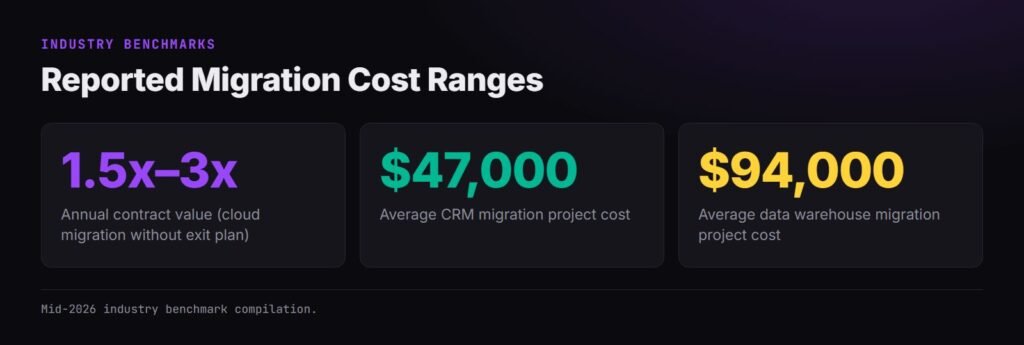
The structural cost of a platform decision becomes visible only when a team outgrows a vendor or encounters a limitation that forces a change. A mid-2026 compilation of cloud-to-cloud migration benchmarks reported that these transitions typically cost 1.5 to 3 times the departing vendor’s annual contract value when no formal exit strategy is in place. For a startup operating on a $50,000 annual software budget, this represents a six-figure expense when fully burdened with engineering time, data migration, and operational risk.
The reason costs escalate so quickly is that software tends to embed itself in a team’s core operations. Custom code, workflow configurations, and deep process expertise all accumulate around a vendor’s specific architecture. Leaving the platform often means leaving much of that accumulated investment behind. A proprietary formula language for calculating key metrics, for instance, requires manual translation. Every formula must be hand-ported, and the new execution model may introduce subtle behavioral differences that require extensive validation. This engineering overhead, rather than data export fees, often becomes the largest cost of a migration.
Platform Scripting and Lock-In
This exact dynamic is visible in the financial charting software market, where reviews of charting platforms break down the specific trade-offs between platform depth and portability. A charting platform’s scripting language is often its deepest source of lock-in. Traders build complex indicators, alerts, and automated strategies in a proprietary dialect that is deeply coupled to the host platform’s runtime, data model, and execution limits.
TradingView’s Pine Script is a well-documented example. It provides a rich development environment directly inside the charting interface, but the resulting code has no standard migration path. TradingView’s October 2026 documentation sets a compiled form limit of 80,000 tokens and lists no official converter to another language. Replicating a suite of custom scripts on another platform requires a full manual rewrite, an investment that can quickly exceed the platform’s initial subscription cost.
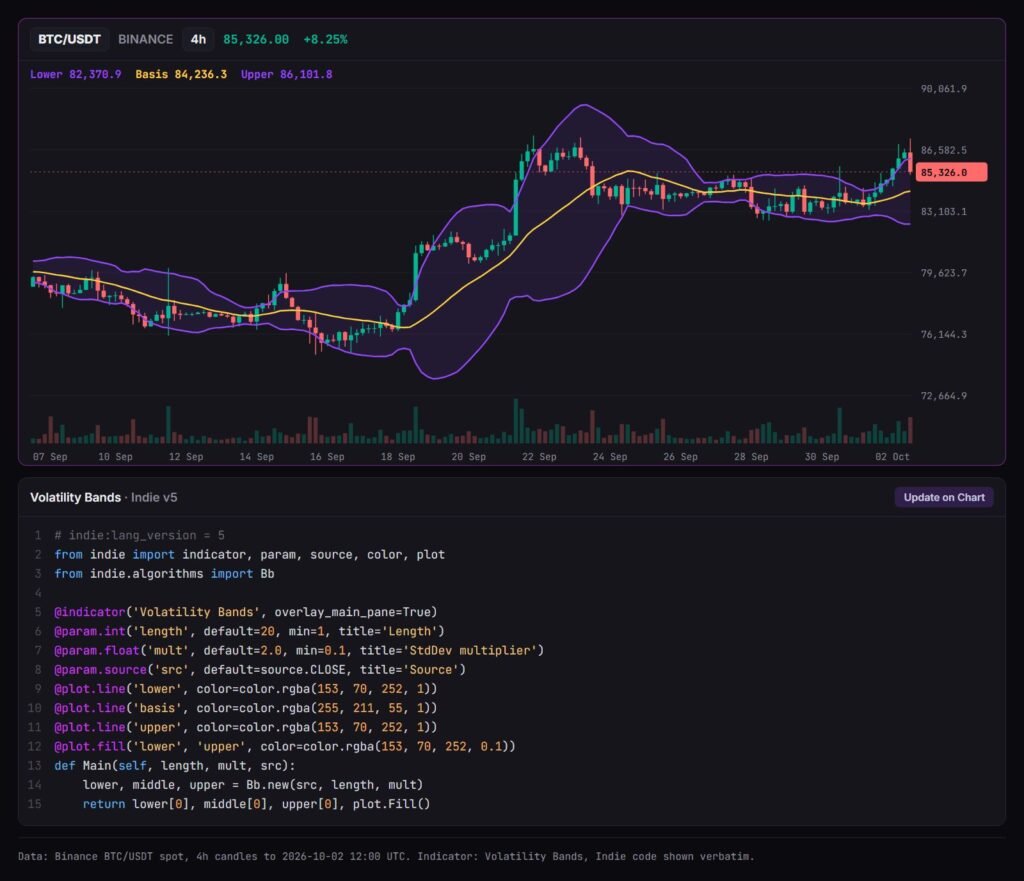
Other platforms approach this problem differently. TakeProfit ships a language called Indie that runs within its own environment but is written in a Python-like syntax combined with trading-specific decorators. The platform publishes the source code for every standard indicator, so a developer can read, inspect, and adapt it – the familiar syntax means that a developer’s core programming skills transfer directly. While the code itself is not portable to another runtime, the team’s accumulated conceptual knowledge has a longer shelf life than it would in a completely custom dialect where fluency cannot be reused elsewhere.

The Shape of Switching Costs
Code portability is the most visible source of lock-in, but it is rarely the only one. The total cost of a migration is built from several overlapping categories.
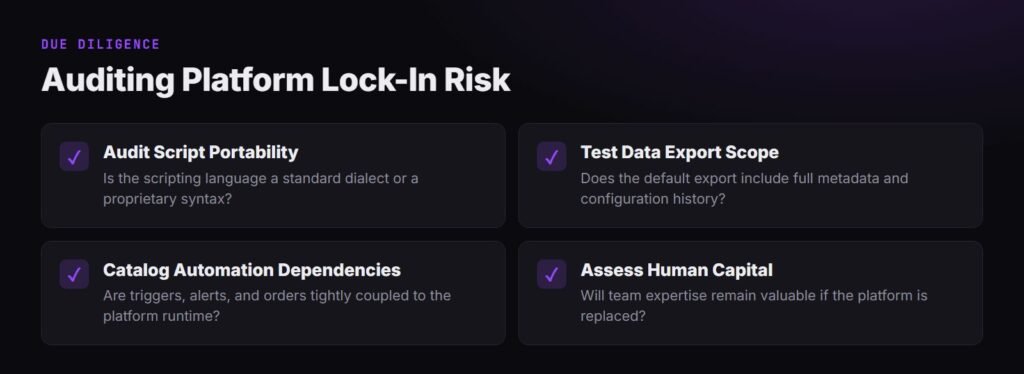
- Data Export Scope: Default export paths may provide a chart image or a subset of data fields, leaving behind the full underlying dataset, metadata, alert configurations, and audit history. For example, a CSV export from a strategy backtest might include only the final profit summary, not the raw tick data or configuration parameters. Recovering this lost context is often impossible.
- Workflow Automation Dependence: Automated triggers, order alerts, and strategy schedules are built around the original platform’s event model, rate limits, and API contract. Recreating these in a new environment means rebuilding integrations from scratch and testing for differences in latency, retry behavior, and error handling.
- Human Capital: Team members accumulate deep, platform-specific knowledge. When a platform is phased out, that expertise becomes a stranded asset. New hires must be trained on the legacy system, or the team must invest in retraining – both direct costs that are absent from the subscription price.

Auditing a Platform Before You Build
The major sources of platform lock-in can be evaluated before a team writes its first custom line of code. The first question to ask is about the scripting layer. Is the language a standard, widely known dialect, or a proprietary syntax with a limited talent pool? Can logic be extracted and tested outside of the platform? Does the vendor support standard version control workflows?
A systematic resource like this ranked list of charting platforms allows a team to weigh scripting flexibility and data access against feature depth before making a commitment. The return on this auditing effort is high because it directly prevents a specific type of technical debt: platform debt. Unlike code debt, which can be refactored incrementally, platform debt requires a sudden, often large-scale investment to escape.
The same logic applies well beyond the charting market. Any platform that encourages deep customization through a proprietary mechanism – a workflow builder, a formula language, or a full scripting SDK – deserves a formal audit of the exit cost. The goal is not to find a platform that is easy to leave, but to know the price of leaving before that price is paid.

Bottom Line
The cheapest platform is rarely the one with the lowest monthly price. It is the one whose total cost of ownership accounts for the eventual cost of migrating away from it. Evaluating a vendor’s technical lock-in – its scripting language, data export capabilities, and workflow model – before significant engineering effort is committed can save a startup multiples of its annual software budget. The questions are straightforward to ask during a product evaluation meeting, but expensive to revisit after a year of custom code and workflow automation has accumulated on top of a platform’s proprietary foundation. A documented exit strategy is not a sign of distrust in a vendor; it is a responsible component of the evaluation itself.